
A Year for a Moonrise
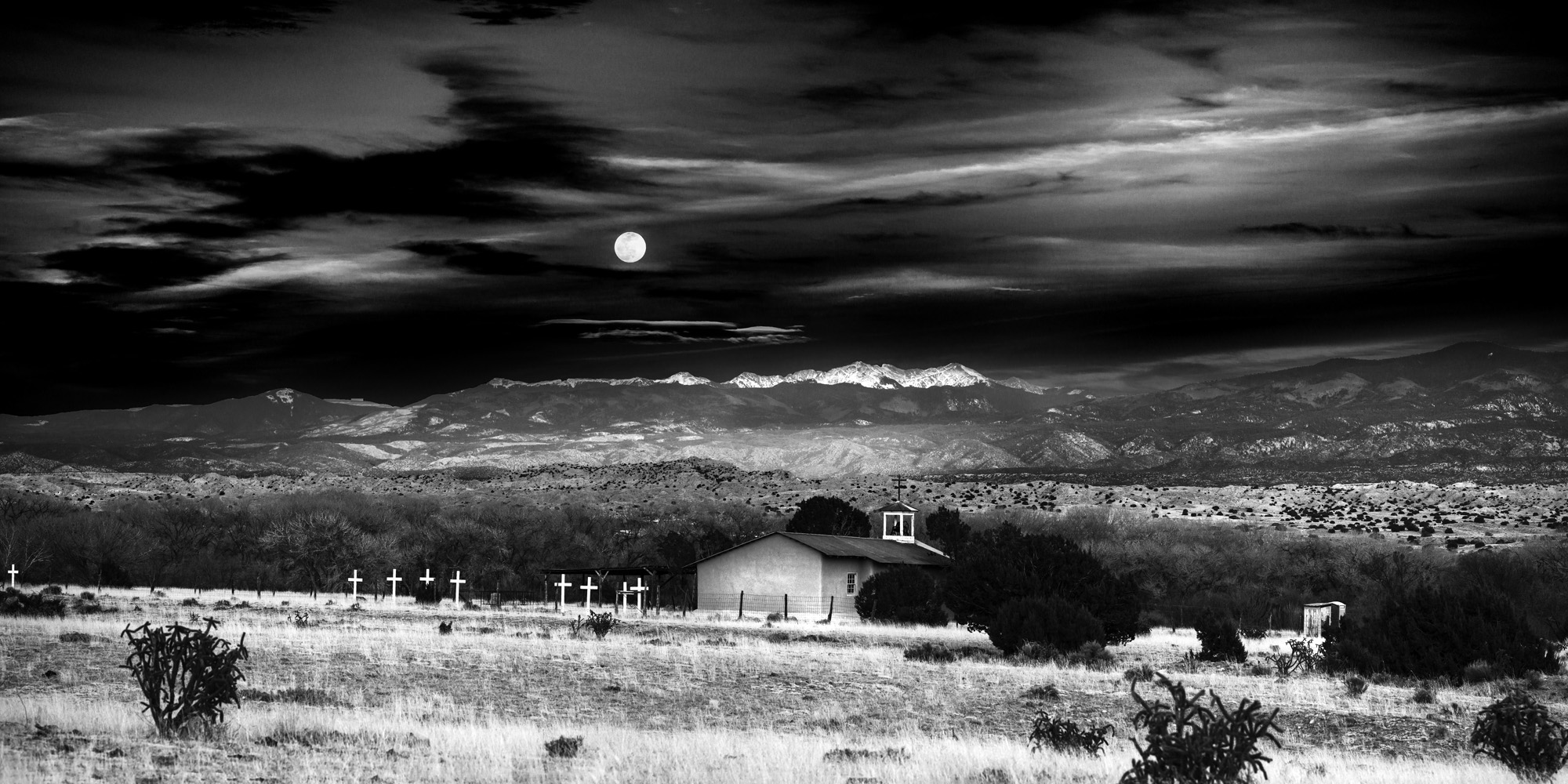
This image started as a line on a map. The moon rises in predictable locations at given times — the trick is knowing where it will rise in a physical sense, when it will rise, when the sun will set far enough below the horizon to allow the greatest detail of the moon to show while still allowing enough ambient light to emphasize the natural geography.
What I wanted for this image was very complex! It had to be in black and white in order to have the proper contrast for the image I had in my head. What didn't exist was the camera system. I wanted an ultra-high resolution image, but in order to achieve what I desired, it needed to be a stitched image. After much contemplation, I decided on using a Linhof 4X5 camera. However, I love the look and feel of my Hasselblad CFV50 images, so I knew I needed to integrate three systems. New digital back, existing 4×5 camera, and old Rodenstock Lenses. This combination created a look and feel that I felt the image in my head needed — but it wasn't without a lot of engineering, building, and testing before the look finally came together.
I've never been the one to "spray and pray" for an image. I love the science behind crafting an image. Where is that moon going to rise? How is the weather going to play against my landscape? What is unique about this subject to me that captivates my mind? How am I going to use the tools I have to make an image that tells a story and reaches people? Do I have to build something to enable me to capture all these elements? My wife often makes the comment; "how are you a photographer if you don't always have your camera with you?" The answer is always easy for me — I need a plan in my head for the image I wish to create, and then I can execute on an image.